Water Exchange Process
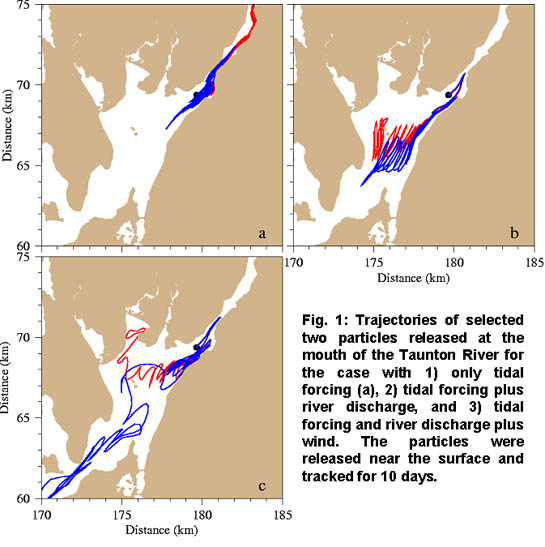
The particle tracking experiments were
conducted to examine the physical process controlling
the water exchange between MHB and NB. Three cases are
described here: 1) only tidal forcing, 2) tidal forcing
plus river discharges, and 3) tidal forcing and river
discharge plus variable winds.
The water exchange between MHB and NB is mainly controlled
by variable winds. This can be clearly seen in particle
tracking experiment results under different physical environments
shown in Fig. 1. In the case with the only tidal forcing,
particles, which are released in the TR, oscillate over
the length scale of a tidal excursion around the mouth
of the river, with increasing downriver and upward movements
each cycle. After 30 days, particles are still in the
surrounding area of the river. When the river discharge
is added, particles move southward with an oscillating
track. After 30 days, particles arrive in the southern
part of MHB. This result is consistent with the subtidal
circulation pattern shown in buoyancy-driven flow due
to river discharges. Adding wind forcing increases the
spatial variability of particle trajectories. Two particles
released at proximal locations followed significantly
different trajectories after 10 days. One particle moves
westward and entered the northern coastal region and the
other moved rapidly southward and entered NB after 10
days. This variability is even more obvious n the case
when large numbers of particles are released: supporting
our argument that the wind is a dominant forcing that
controls the variability of the water exchange between
NB and MHB.
To see
the movements of the large number of particles in three
cases described here, please click the picture below.
|


